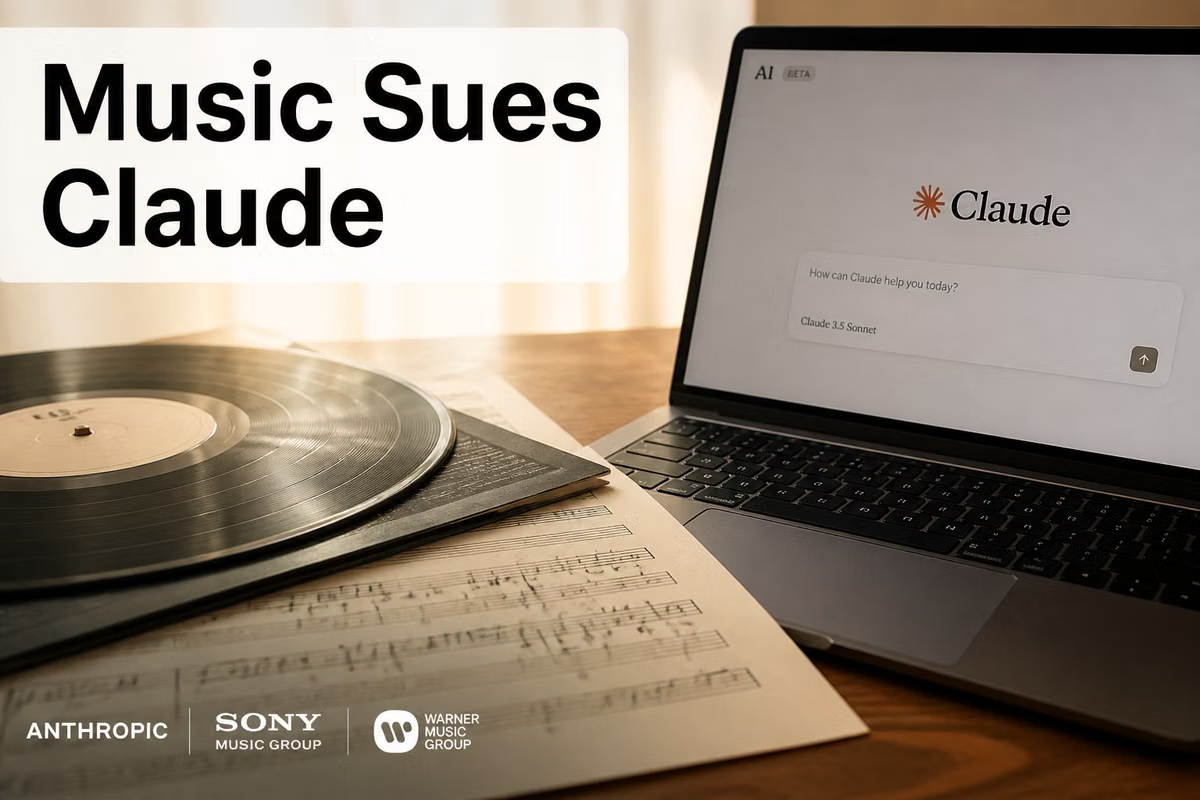
Two of the biggest music catalogs in the business just sued the company behind Claude. The Verge reported on August 29, 2026 that Sony Music and Warner Chappell filed in U.S. District Court for the Northern District of California. They want damages for tens of thousands of copyrighted works. The complaint names co-founders Dario Amodei and Benjamin Mann as individual defendants.
Most of us meet Claude as a chatbot. This filing treats the people who built the lab as part of the alleged copying, not only the corporate name.
The dollar figures are a ceiling, not a bill that has already come due. The publishers ask up to $150,000 per work, plus up to $25,000 per instance of stripped copyright-management data. That second ask is about the tags that say who owns a file, not only the song itself. The Verge says that if a court awarded those numbers at the top end, max statutory damages could reach several billion. I would not treat "several billion" as money already owed. Statutory damages are the legal maximum on the books, and a judge can go lower.

What they say happened is blunt. The publishers call it a brazen campaign of illegally torrenting, scraping, and downloading copyrighted works to train Claude. They allege Mann used BitTorrent to download over five million pirated books. They say employees downloaded at least two million more from Pirate Library Mirror. They also claim Anthropic scraped lyrics from MusixMatch and LyricFind. BitTorrent is how large files get pulled from lots of other computers at once, which is why it shows up in piracy cases. MusixMatch and LyricFind are lyric services. Scraping them, in the publishers' telling, is how song words got into the training pile.
The song list is the part most people will recognize. The complaint names Ain't No Mountain High Enough, Livin' On a Prayer, September, Hallelujah, and Taylor Swift's Paper Rings. Those titles are not a playlist Anthropic published. They are examples in a lawsuit. If a lab used the words of a hit song to train a model, music companies now want the same accounting that book authors already demanded.
That is why music is joining the author cases. A training-data lawsuit is an argument about the raw material that made the model, not about one chat you had on Tuesday. Book authors care about novels and articles. Music publishers care about lyrics and the catalogs those lyrics sit in. Once you treat "the model learned from this file" as a copy, every catalog owner has a similar complaint. The file type changes. The legal theory does not.

Anthropic has already been down a version of this road. The company recently settled a publishing and authors case for $1.5 billion. It also faces suits from Universal, Concord, ABKCO, BMG, and Round Hill Music. Sony and Warner are not the first music names in line. They are the latest big ones.
I do not treat a complaint as a verdict. TechCrunch later reported that Anthropic said it disagrees and will defend itself in court. That is the company's public line so far. We do not have a ruling. "Alleged" is doing real work in this story.
If you use Claude, you do not need to panic about last week's homework. You should watch the rulebook. These cases are about how the lab built the model. If courts keep treating unlicensed books and lyrics as off-limits fuel, labs will have to license more, settle more, or argue fair use in front of a judge. Any of those paths can change what a model will recite, what it will refuse, and how expensive it is to run.
The useful habit is small. Do not paste a famous chorus into a chatbot and assume the song is public property because the model knows it. Watch whether Claude gets more careful with lyrics, and whether labs start announcing licensed catalogs the way streaming apps already do. The $1.5 billion authors settlement already showed that training data is not a free pile on the internet. Music is now asking for the same ledger.