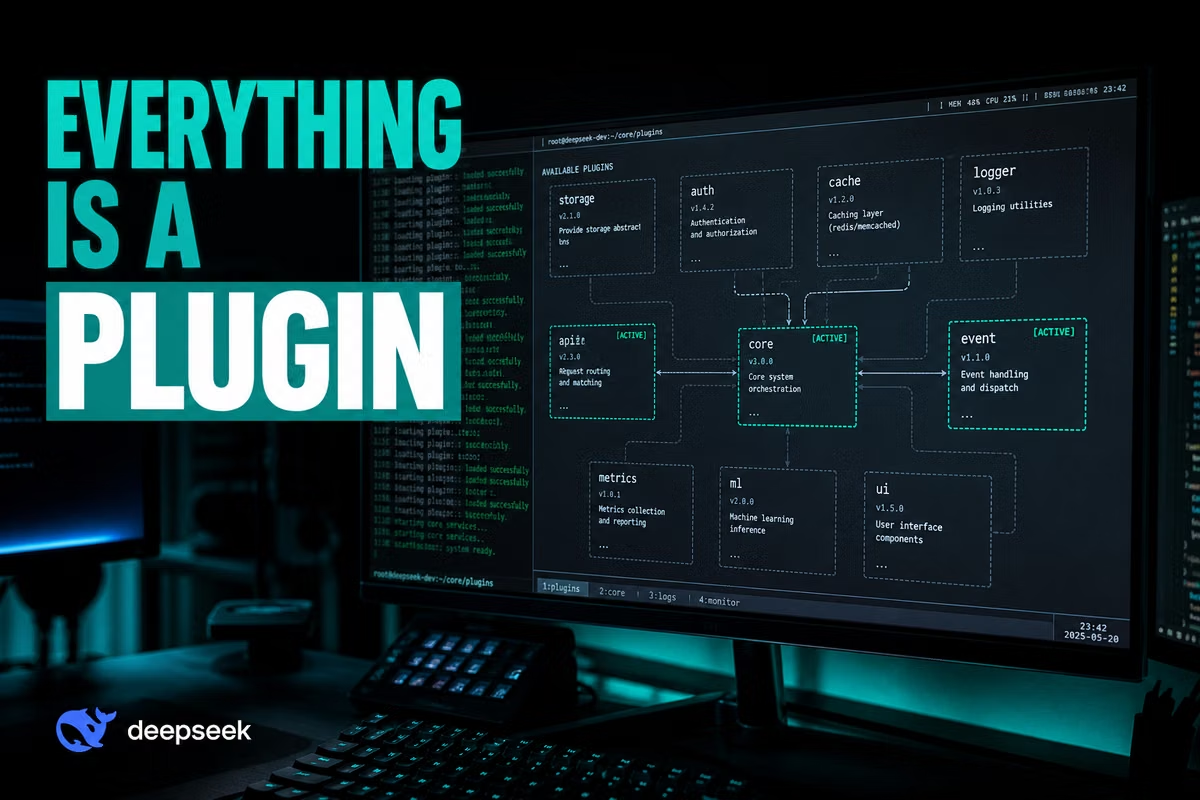
DeepSeek releases early open source developer preview of its agent harness . The Register, August 14, 2026. Everything is a plugin, the company said in a single sentence. Plugins can be models, tools, skills, sessions, sandboxes, filesystems, loops, orchestration or UI. You can pair them, mix them, replace them, make them larger. News: The brief stated it was MIT licensed and used the Cordis meta framework. It didn't say license on the Register. It shaped the drop into an early free to use version.
If you're using Cursor, Claude Code, or Codex, you're already using a harness. Sorry, you can't say that.
What’s a harness 2026 This year, “harness” became a term for a middleware or mediation layer between you and the model. In this case it controls the agent loop, state, errors, safety, permissions and prompts. Anthropic’s tool is called Code Claude. Codex, created by Open AI. It's the same thing Aider, Cline, Goose, OpenCode, OpenHands and Pi all do. Google Antigravity breaks this down into an Agent Runtime (the harness) which can be accessed via an Agent SDK, desktop app, or command line interface (CLI).
The word is still not snug. Or "Only the tools and the ring." Sometimes it means stack, sandboxing and the rest of the stuff. It’s the same business deal. Models are looking more and more alike. Products are different because of the way. The harness has inertia in the UI. Your tools and muscle memory are attached to one app , and it is more expensive to switch between editors or CLIs than it is to a benchmark chart.
The harness also changes the scoring for the same model. The design choices influence how things behave and their price tag. Pi has a system prompt that is about 200 tokens. Claude Code had a prompt that was about 10,000 tokens until Anthropic cut it by about 80% last month . Same weight, different wrapping, they behave differently.
Chinese labs are now competing on this level, as well as model scores and price, according to The Register.
It just all fits in.
DeepSeek Harness is built on the Cordis base. Plugins let agents do models, tools, skills, sessions, sandboxes, storage, loops, scheduling, and the UI. These plugins talk to each other via Cordis events and services. Developers are able to change, replace or add any configuration feature without any changes on the source code of DeepSeek Harness.
This could be claimed by those who split off a coding agent just to change a sandbox, a model adapter or a session store.
In their paper on Cordis, Yifan Shi, Wei Zhang and Tianyi Cui call this the property of dynamic composability. This property states that plugins can be added or removed from the app at any time without breaking the app. That was divided into two parts.
Take a part away, and its effect disappears. That’s temporal composability. Once the plugin is removed, the system is no longer supposed to behave in a certain way.
Spatial composability is the ability for parts to manage their own dependencies. The graph of who needs whom is simple.
This is unlike VS Code in the paper. VS Code extensions run in a shared process with other extensions. Once an extension is activated, it cannot be withdrawn at any time. The host needs to be restarted. VS Code supports extension-to-extension dependency declarations, but you don’t have to. DeepSeek Harness supports plugin dependencies.
All the time, changes happen with little help from people, and these need to be able to be put together in time and space, the authors say. It’s an agent that can evolve its own set of skills and incorporate new tools while it’s active. You can even restart the host, instead of comparing with VS code.
If you’ve shipped a plugin host before (webpack, Vite, VS Code, a design-system runtime), you know what the hard part is: Adding a module is easy. It's very hard to unload it, and fix what it did, and do that as the process is still working. Cordis tries to do that for an agent stack automatically.
Importance of hot-swap in a code agent
Code agent is not the same as plain CLI. Tools, skills, subagents are built up over the course of a session, in this long term process. Cursor, Claude Code, and Codex, together, make a session more powerful over time. That growth is a big part of it. Building on that. If something is acting up, the usual way to fix it is to restart.
Another contract is a plugin graph that can be folded up in time. The Cordis paper says you can remove a component and it will revert to the way it was. Dependencies are not taken for granted but are also managed. When using a harness, what is the difference between "restart the agent" and "unmount the sandbox plugin"? It’s more like how frontend runtimes mount and unmount already. Add a feature, take it away, clean up.
It also changes the way customization is supposed to work. DeepSeek says you change config not copy Claude Code or patch for Codex DeepSeek says you change config not copy Claude Code or patch for Codex . According to the DeepSeek Harness website, developers are able to choose, modify or add to any configuration feature without changing the DeepSeek Harness source code.
Coverage doesn’t tell you if that configuration surface is nice, well documented or stable. This release is a developer preview.
The log shows the whole thought process.
The second design choice is about what can be seen.
There is an append-only session log that records all activity in the model, such as system prompts, reasoning, tool calls and results, subagent scheduling, and all context injections. In the Trajectory view, you can see these records by source. You can resume, split, search and play back on the same event stream.
The session is not just a chat transcript with a secret start. You can watch and play the log.
You can use intermediate reasoning to answer a few questions, like how well the model thinks, how accurate a response is, and how more “thinking” changes the output. DeepSeek R1 learned to use chain of thought last year, meaning it can break a prompt up into thoughts and then think about and answer them. The newly released DeepSeek-V4-Pro and V4-Flash come with the thinking mode enabled by default.
The big U.S. labs have been moving the other way.
Some models of Anthropic still allow you to think when extended or adaptive thinking is available, but it has been hiding or summarizing the raw chain of thought. That seems to have to do with the risk of distillation, i.e. traces can be used to copy a model through a normal research process. Earlier this year, Anthropic said it had rolled out classifiers to identify chain-of-thought elicitation, which is used to produce data to train reasoning. The business doesn’t reflect the raw chain of thought The text in a thinking block is a summary of what Claude thought. “If you want the raw thinking, you have to contact Anthropic sales.”
OpenAI also has decided to hide the chain of thought it uses to track its models, but not for its open source models. It said it considered user experience, competitive advantage and the possibility of pursuing chain-of-thought monitoring when it launched o1 two years ago and decided not to show users raw chains of thought.
DeepSeek considers the entire trace to be readable. The Register says that there is likely to be competition over access to chain of thought, a well-established open source model ecosystem.
You can really feel the difference if you are debugging a bad tool call in Cursor or Claude Code. This collapsed thought block shows you the file the model looked at. Each context injection has an append-only log. The log tells you which prompt fragment, tool result, subagent, and whether you can resume, fork, or replay from that event.
What we don't know about
This is an early developer preview. “As the Register says, it’s early yet. Coverage is not a sign that production is ready to go. It doesn’t talk about the breadth of the plugin ecosystem, how the editor interacts with it, or how the preview works into an existing Codex, Cursor or Claude Code workflow.
We also don't know if you should switch.Changing the harness is not changing a model. The harness is the UI, the permissions model, the session format, the muscle memory. It’s hard to get around in this market. A plugin-first design should make changing a piece later cheaper. You still have the price of leaving behind a tool you have now set up.
One of the co-founders of Earendil, now leading the Pi agent, said, "I don’t think the DeepSeek Harness is a perfect example but it’s the first time I’ve looked at something new in the space that has made me quite inspired to revisit some of our choices. “I love that Open Source part so much!” he wrote.
The Register piece is not interesting because it's a new chat window. In this runtime the model and the loop and the sandbox and the UI are all one same thing, a plugin. The session is a log you can copy.