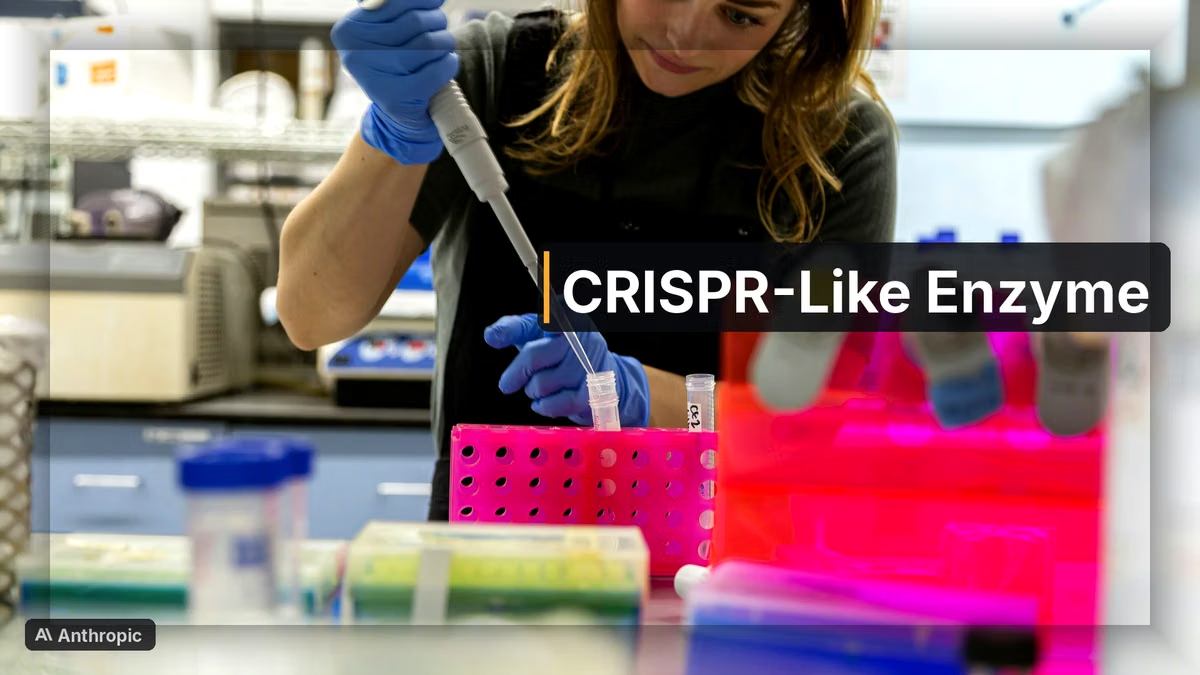
Anthropic says its Bay Area wet lab has found an enzyme system in bacteriophage DNA with properties reminiscent of CRISPR. TechCrunch reports the system can support cut, copy, and paste style DNA operations. The company says the work ran with about 950 Claude agents over 21 hours and about 210 million tokens, and that Claude did most of the discovery work while humans handled the lab steps.
Those lab steps stayed in BSL-1 and BSL-2 conditions with no human pathogens. CEO Dario Amodei noted that Stanford researchers found a somewhat similar system, and he stressed that the broader community still needs to validate the claim. The Verge covered the same numbers. Amodei has not ruled out Claude controlling lab equipment later with safeguards, but that is not how the lab works today.

The scale number is the developer hook. Nearly a thousand agents burning through hundreds of millions of tokens is not a single chat window. It is a research cluster pointed at sequence hypotheses, then narrowed until something looks worth a pipette. Humans still own the wet steps, which is the right split when the stakes are physical.
For software people, the interesting part is the workflow, not the biology jargon. A swarm of agents chewed through sequence space at a scale that would crush a solo researcher, then handed candidates to humans who could pipette and plate safely. That split is the product pattern: models propose, people verify in the physical world, and the claim only counts after outside labs reproduce it.

If you build research agents, copy the boring parts of this setup. Cap tool access. Keep wet work behind human approval. Log every hypothesis the model pushes into an experiment queue. Publish enough detail that independent groups can try to break your result. Anthropic is inviting that scrutiny, and Amodei's Stanford note is a useful humility check.
I would also version every agent prompt and tool grant the way we version infra. When nine hundred agents run overnight, you need to know which policy let them request which experiment. Reproducibility for AI-led science starts as software hygiene, not as a press release after the enzyme looks exciting.
I like this direction when labs treat AI as a search engine over biology rather than a magic oracle. CRISPR remade genetic editing once outside groups confirmed it. A Claude-led enzyme find only becomes useful the same way. Until then, treat it as a strong lead from a well instrumented agent stack, not a finished platform you can buy next quarter.