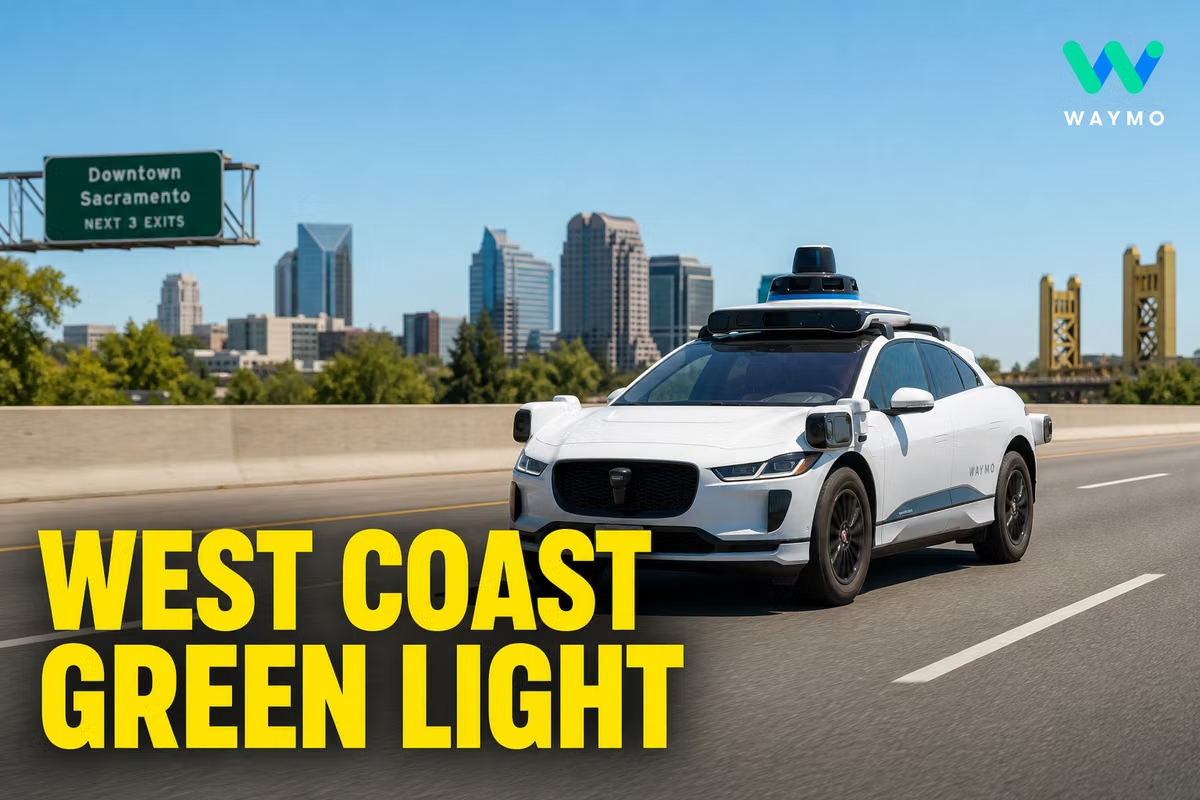
On August 14, 2026 Waymo announced that it had been granted approval by the California Public Utilities Commission (CPUC) to expand its self-driving taxi service. The company said the news was three firsts: first-time service in Sacramento and San Diego, plus room to grow in the Los Angeles and San Francisco Bay Area. The same day, Ian Carlos Campbell reported the news for Engadget. We at Electrek have already pointed out the paper trail.
That's the title. If you ship maps, geofences, or city-by-city feature flags, you need to understand the difference between “approved” and “live.” The commission also would let Waymo expand its service area, the company said. What I am saying is not that robotaxis are already ferrying people to every new county name. The company said its growth will be slow and governed by its safety framework. Engadget has learned that Waymo will not be deploying robotaxis across all 18 counties simultaneously. That's a permission bit turning on, that's a market turning green in the client's brain.
The other side of the story is the 18-county list. Rides should now be available in Alameda, Contra Costa, Marin, Napa, Sacramento, San Francisco, San Mateo, Santa Clara, Santa Cruz, Solano, Sonoma, Yolo, Los Angeles, Orange, Riverside, San Bernardino, San Diego and Ventura. These names occur in northern and southern California. They are not all in the same metro polygon. This is Sacramento, in the Central Valley. San Diego is a city in the southern part of the state. The Bay Area cluster covers Alameda, Contra Costa, Marin, Napa, San Francisco, San Mateo, Santa Clara, Santa Cruz, Solano, Sonoma and Yolo counties, which are near each other but have very different street grids, hills and weather along the coast. The southern group includes Los Angeles, Orange, Riverside, San Bernardino, San Diego and Ventura. It also is a wide band that extends from the coast to the middle of the state.
That list is like Engadget. Be careful. The news outlet contacted the CPUC for comment on the Waymo decision and said it would update the story when it heard back. The county list and vehicle types below are from Waymo’s announcement and Engadget’s reading of a January letter. They are not from a confirmed CPUC press release that is part of the public record as of August 14. If you’re making a service-area layer, that’s not a stamped commission map. It’s a “source: company + reporter’s reading of a filing” data set.
At least in the version compiled by Electrek and Engadget, the approval is only present because of the January letter. Waymo said in November 2025 it would grow its California footprint. In January it wrote to the CPUC asking them to approve a safety plan so it could offer rides in the bigger area. The commission said what they believed. The CPUC’s page says at one point, the request was put on hold. Waymo’s Aug. 14 announcement makes it seem as if those problems have been solved. But Engadget says it doesn't seem that resolution is available to the public just yet. That hedge is vital. The business says it is all right to do it.” The reporter adds that the paper trail isn’t complete and the regulator hasn’t independently confirmed the story to Engadget.
If you've ever shipped a staged rollout as a front-end engineer you'll be familiar with the shape. There’s a plan. Reviewer notes. The request ends. Later the product team says the block is gone, but the public tracker has not yet caught up with the change in the status of the ticket. You can ship the moment the news hits, or you can wait for the tracker. TechRadar is waiting on the tracker or at least a response from the CPUC.
Intent’s time frame is clearer than cars on the road’s time frame. Waymo said in November 2025 that it was expanding to San Diego. It said in February 2026 it planned to expand into Sacramento. In July the company said it would soon test rides without a safety driver in San Diego, Denver, Tampa and Las Vegas. Those are not launch calendars. Those are blueprints. The August approval is the portion of California’s rules that, if Waymo’s safety plan is approved by the CPUC, would allow paid or public self-driving taxis to operate in the newly renamed counties. The Engadget report doesn’t say when it will start in Sacramento, San Diego or the Bay Area or Los Angeles only that it will cover more areas.
That is how it goes. That is the story. Permission is a large form. Service is a collection of increasing flat polygons. Waymo itself says it will grow slowly and in accordance with its safety framework, according to Engadget. The company is not promising that all 18 counties will go live simultaneously. Here, a user opens the app in one of the 18 counties mentioned in the press release, but the pickup pin is still gray. This has happened before, with a serviceArea flag, a geofence GeoJSON, or a city allow-list. The reality of the product post this news is that the “regulatory envelope” has gotten bigger, but live coverage is still decided by Waymo’s safety process and not just the list of counties.
The other detail about implementing the plan in the January letter is vehicles. According to Engadget, the first filing means that the CPUC should allow Waymo to run both its new Ojai robotaxis and existing Jaguar I-Pace vehicles. The Ojai is a bespoke minivan made by Chinese automaker Zeekr. That is not one body style, but a fleet of different types of ships. The I-Pace is the SUV-shaped vehicle that many riders already associate with Waymo in the cities where the service is available. The Ojai is a newer van platform. The story doesn't say how many of each type will be used in California, which counties will get which type of vehicle first, or when Ojai units will show up in Sacramento or San Diego. It also does not quote a line of CPUC that lists the names of the vehicles. Engadget obtained Waymo’s letter and created the list of vehicles as the commission was still working through its own confirmation.
A mixed fleet is not just a picture on the car card for a maps or mobility client. An I-Pace’s pickup geometry, number of doors, cargo space and curb fit are different than those of a minivan. An Ojai in the same service area is not just a hardware problem but a problem with the app seeing the vehicle silhouette. The source does not say those things about the product. It only says that the permission should be for both types as read from the letter.
The tweet of Aug. 14 adds a tone, not a timetable. Engadget quotes and embeds Waymo’s post saying, “Big news for California: the company has received approval from the CPUC to expand autonomous ride-hailing across the SF Bay Area and LA, as well as to bring the service to Sacramento and San Diego.” The company says the expansion will be slow and guided by safety rules. That’s what the company publicly says. Fits the first two and growth structure. It does not fill in prices, fleet size, or a calendar for each county. That info isn't in the Engadget piece, and don't make it up.
The same caution applies to 'what is live today'. Waymo already operates in parts of California. No, the news isn't that the business is starting over in Los Angeles or San Francisco. The good news is the approved envelope is larger, and Sacramento and San Diego are in it for the first time. The report doesn’t tell us how much of the Bay Area or Los Angeles is already bookable, or how much of the newly listed inland or coastal counties are still dark. After this article a real map has a thick layer named "approved" and a thinner layer named "operating" which is still not clear.
Put the July out-of-state note in a separate pile. Questions on Denver, Tampa and Las Vegas are not standard the California CPUC. San Diego was a California city in November 2025, but now it’s an August approval story city. It was listed as a “soon” city for driverless testing without a safety driver in July. There are three different verbs there: plan, test and (if approved) offer rides under a more thorough safety plan. If you were to combine all of these into a single event that said "Waymo is launching in San Diego", it would make the source look bad.
In this case unknowns are apparent. That Engadget article doesn’t say when it’ll begin in Sacramento or San Diego. It’s not saying when the Bay Area or Los Angeles will get even bigger. It just quotes Waymo and the reporter's interpretation of the January letter. It doesn't say what the fleet size is, how much it costs, or what the CPUC says. It doesn’t say the suspension and subsequent resolution are already written into a public order from the CPUC that Engadget has seen. The news outlet asked the commission for confirmation and said it would notify everyone if it received a response. Until then, the county list and the pairing of the I-Pace with the Ojai and the Zeekr should be considered Waymo’s announcement plus a reading of the filing.
For someone who thinks in terms of service-area flags, the clean model is three states. In November of 2025 and February of 2026, they wanted to do something, they named San Diego and Sacramento, before any August permission story. There were two things: the January safety plan request, the feedback, and the suspension on the CPUC page. The August tweet says the review process is done, but Engadget points out the public record hasn't caught up. Third, a live, slow rollout that follows Waymo’s safety rules. The company says it will not roll out robotaxis into all 18 counties at once. If you ship a user interface that treats all three of those as true, you get a "available in your city" badge that is legally correct but not useful.
Another reason is geography. There shouldn't be just one toggle. There are not 18 counties that comprise a single API region. Yolo is not Big Bear City. The City of San Diego is not Riverside. Even if the letter is written at the county level, a gradual rollout of the safety framework almost certainly means it will be enabled per metro, per neighborhood, or per corridor. The article fails to mention that cut on the inside. It just says the entire list won't be ready on day one.
There are few facts, as Campbell’s report on Engadget Aug. 14 noted. Waymo said CPUC approved its plan to expand its autonomous ride-hailing footprint. That includes first-time service in San Diego and Sacramento and more room in the Bay Area and Los Angeles, the company said. Engadget links the claim to a safety plan letter sent in January about the area Waymo announced in November 2025, and also points out a suspension and no public write-up and is awaiting a response from the CPUC. That was reported and not a press release from the commission. The 18 counties and mix of the I-Pace and the Ojai/Zeekr are part of that picture. The source lacks information on launch dates, fleet counts and prices.
To sum it up: You should think of this as a bigger permission envelope for California and not a launch day. If you have a map or city flag, make sure “CPUC approved per Waymo/Engadget” isn’t the same as “bookable here tonight.” And wait for the commission to confirm all 18 counties are live before hard-coding them.