On Friday, August 14, 2026, Anthropic published a blog post that answers a set of practical questions about how Claude will watermark the text it generates. Anthony Ha reported those details for TechCrunch on August 15. The company had already said earlier in the week that watermarking was coming. The Friday post is the more technical follow-up: how the mark is written, what happens if you edit the output, and what this means for code.
The stated reason is compliance, not a product experiment. Anthropic is following the EU AI Act’s Transparency Code. That code requires systems that make it possible to identify AI-generated content. Other major labs that signed the same Code of Practice are expected to add their own watermarks. Claude is not a one-off case.
If you ship UI and you sometimes ask Claude for button copy, empty-state text, or comments above a tricky hook, this is the part that matters. The mark is not a footer, a hidden character, or a visible stamp. It lives in the sampling path. When the model has more than one acceptable next word, it can steer that choice with a secret key. A reader does not see the pattern. Anyone who has the key can test for it.
How SynthID-Text works in plain terms
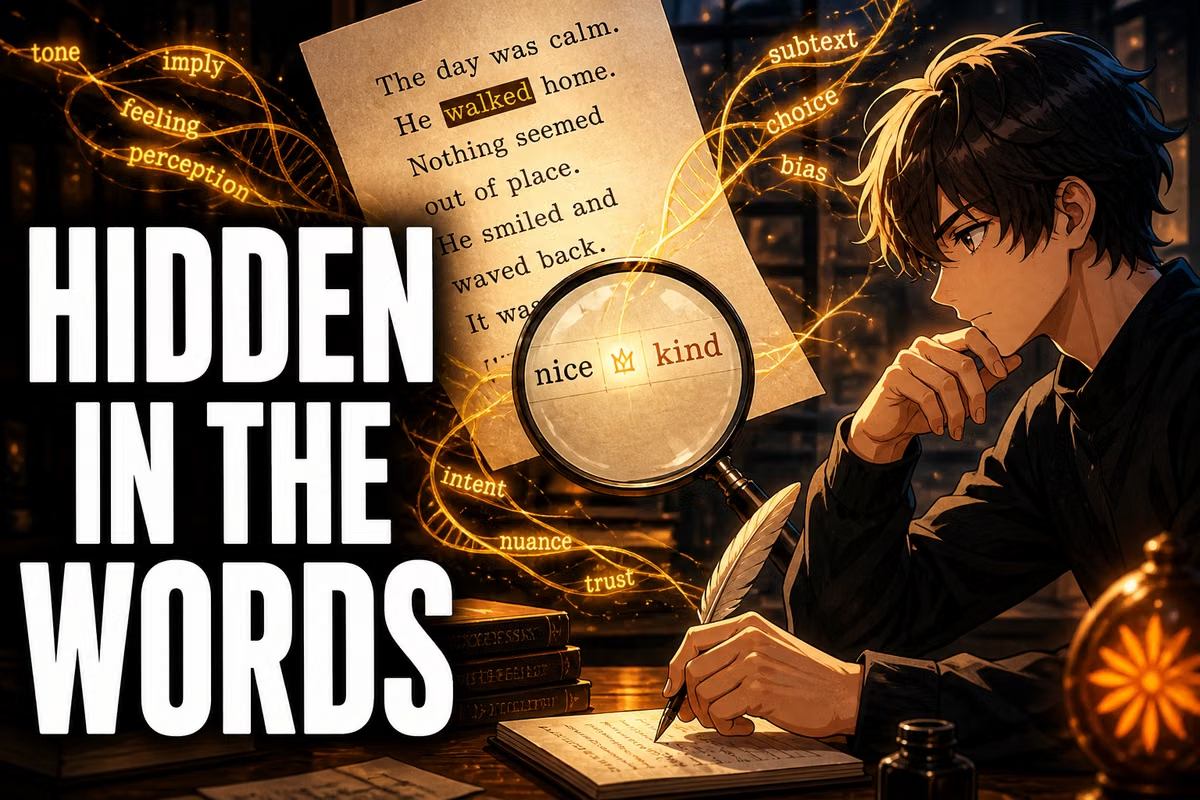
Anthropic said it will use Google DeepMind’s 2024 SynthID-Text method. Language models do not emit a full paragraph at once. They pick the next token, then the next, over and over. At many of those steps the model has a short list of words that are all fine. The example from the company is weather language: “overcast” versus “grey.” Either word can finish the sentence. The meaning does not change. Those are the “low-stakes” choices.
Without a watermark, the model uses ordinary randomness to break the tie. With SynthID-Text, the secret key biases that randomness. Over a long enough passage, the sequence of those small choices forms a statistical pattern. The pattern is not a slogan you can spot by eye. It is a signal that a detector with the key can score.
Think of it as a seeded sampler, not a filter. The model still has to pick a word that belongs in the sentence. It is not inserting a payload after the fact. It is changing which of two good words wins when both would have been acceptable. Do that enough times and you get a trail. Miss those interchangeable spots and you get almost no trail.
Anthropic’s quality claim is direct. The company says watermarking does not change the quality of Claude’s output. A watermarked response is indistinguishable from an unwatermarked one to a reader. You should not expect a new voice, extra hedging, or a drop in fluency from the mark itself. The mark is in the sampling, not in a post-process that rewrites the answer.
This is also why the method is a poor fit for places where the next token is not interchangeable. If only one word is correct, there is nothing low-stakes to steer. That limit shows up in two places frontend work cares about: factual strings and working code.
What survives an edit
The obvious question is whether you can wash the mark out. Anthropic’s answer is graded, not binary.
Light edits probably will not fully strip the mark. If you change a heading, swap a few adjectives, or tighten a paragraph, enough of the original token sequence can remain for a detector with the key to still see a signal.
A complete rewrite, where every word is replaced, will remove it. Anthropic added a caveat that is more interesting than the technical point: in that case, it is arguable whether the text is still AI-generated. The mark tracks the words Claude chose. If none of those words remain, the remaining document is a human rewrite, even if the first draft came from the model.
There is a middle case that will come up often. You write the copy. You paste it into Claude and ask for a proofread, a tone pass, or a shorter version. Whether a watermark is detectable then depends on the length of the text and how heavily Claude edited it. On a light edit, nearly all the words are still the human’s. There is very little for the watermark to attach to. A heavy rewrite is the opposite: Claude is choosing most of the tokens, so the mark has room to land.
For a UI engineer, the practical split looks like this. A full empty-state paragraph generated by Claude is a good candidate for a detectable mark. A human-written paragraph that Claude only cleaned up is a poor one. A human draft that Claude recast from scratch sits in between, and the Friday post does not give a numeric threshold. There is no published cutoff for “enough tokens” or “enough substitutions.” The rule of thumb in the post is qualitative: more Claude-chosen words means more surface for the mark.
That also means mixed documents will be messy. A screen that contains a human-written headline, a Claude-generated helper sentence, and a later human polish is not one object with one status. The watermark attaches to the words Claude picked. It does not stamp the file, the commit, or the author.
What happens to code
Code gets less watermarking than prose. The reason is mechanical. The model has to produce working code. There are fewer interchangeable tokens. You cannot swap a framework API for a synonym and keep the same program. You cannot rename a DOM method because it sounds nicer. Those tokens are constrained.
Arbitrary choices can still carry a mark. Comments are the example Anthropic gave. Comment phrasing that could go several ways is closer to “overcast” versus “grey.” The company says the effect on the actual code produced is negligible. The mark is not supposed to change whether the component compiles, whether the hook dependency array is correct, or whether the class names match the markup.
If you use Claude mainly for implementation and only lightly for comments, the watermark story is thinner than it is for marketing copy. If you use Claude to write the comments, the README blurb, and the changelog line, those strings are where a mark is more likely to live. The executable part of the file is the weaker carrier. The natural-language part is the stronger one.
That split is useful in a review. A pull request that is mostly typed code plus a one-line comment is not the same object as a pull request that is a generated component plus a generated explanation. The Friday post does not say reviewers will get a per-hunk score. It only explains why code, as a class of output, carries less of the mark than open prose.
Detection API versus style detectors
Anthropic plans a watermark detection API. That is a different product category from the AI detectors many teams already know.
Style detectors, such as Pangram, look for writing “tells.” One example in the reporting is the construction “this isn’t X, it’s Y.” Those tools score habits: repeated rhetorical shapes, favored transitions, a certain kind of balanced contrast. They do not need Anthropic’s key. They also do not prove that a specific model wrote the text. They infer a style.
Checking a watermark is different. It is a keyed test of the sampling pattern, not a guess about voice. A detector with the key is asking whether the low-stakes word choices line up with the secret. A style detector is asking whether the prose sounds like a model. Anthropic made that distinction explicit: picking up style patterns is fundamentally different from checking for a watermark.
For a team that reviews PRs, that split matters. A style flag on a comment block is an opinion about tone. A watermark hit, if and when the API exists, is a claim about Claude’s sampling. The Friday post does not say what the API will return — a yes/no, a score, or a confidence band — only that a detection API is planned.
It also does not say the API will catch other models. SynthID-Text as described here is a keyed method. Other labs that signed the same Code of Practice are expected to add their own watermarks. Those marks are not described as sharing Claude’s key, and they are not described as using the same detector.
The EU context
The policy driver is the EU AI Act’s Transparency Code. The requirement is identification: systems that make it possible to identify AI-generated content. Anthropic revealed the watermarking plan earlier in the week. The Friday post is the detail pass.
Other major labs that signed the same Code of Practice are expected to add their own watermarks. That implies a world where several models leave keyed marks, each with its own method and key, rather than a single industry-wide stamp. The TechCrunch report does not say those other marks will also be SynthID-Text. It only says other signatories are expected to implement their own.
User reaction has already split. On Reddit, the debate ran from conspiracy claims to the line that the only reason you would not want this is to lie. Business Insider reported that “dozens” of users on X claimed they canceled Claude over the change. That is a small, self-reported sample, not a churn number from Anthropic. It is still part of the week’s record.
What we do not know
The Friday post and the TechCrunch write-up leave several operational questions open.
Rollout date is not specified in the reporting summarized here. We know the plan and the method. We do not have a ship day for watermarked responses, or a date for the detection API.
Who gets the key is also open. The method only works as a detector for anyone who has a key that encodes it. The post does not say whether that is Anthropic alone, EU regulators, enterprise customers, journalists, universities, or a public endpoint behind the planned API. An API could expose a check without handing out the raw key. That design choice is not in the source.
US versus EU is the third gap. The legal hook is the EU AI Act’s Transparency Code. The reporting does not say whether watermarking will apply only to EU users, only to EU-hosted traffic, or to every Claude response worldwide. For a frontend developer on a US team who pastes Claude copy into a product used in both regions, that scope question is the one that decides whether this is a local compliance feature or a global change in the model’s sampling.
We also do not know how other labs will implement their marks, how detectors will handle mixed documents, or how a file that contains both constrained code and free-form comments will score. Those are follow-on questions. They are not answered in the Friday post as reported.
What is settled enough to plan around
A few points are firm.
The mark is statistical, not visible. It is written in low-stakes word choices, using Google DeepMind’s 2024 SynthID-Text, steered by a secret key.
Quality, as claimed by the company, does not change. The reader should not see a new register.
Light human edits are unlikely to erase the mark. A full rewrite is. Light Claude edits of human text give the mark little to attach to. Heavy Claude edits give it more.
Code is a weaker carrier than prose because working programs have fewer interchangeable tokens. Comments and other arbitrary phrasing can still carry a mark. The effect on the code itself is described as negligible.
A watermark check is not a style check. Pangram-class tools look for tells. Anthropic’s planned API is meant to look for the keyed pattern.
The reason is the EU transparency rule. Other major signatories are expected to do something similar. The open questions are when it ships, who can run the check, and whether US traffic is in scope.
Until those answers land, the useful habit is to treat Claude prose as marked and Claude code as mostly unmarked except where the model had room to choose wording. That is what the Friday post actually supports.
Short take: If you use Claude for UI copy, treat the output as marked unless you rewrite it. If you use it for code, worry less about the implementation and more about the comments. The detection API will be the useful surface, not another “this sounds like AI” linter. Until Anthropic says who holds the key and whether the mark is EU-only, assume the sampling change is coming and plan reviews around copy and comments, not around a visible stamp.